MA-CO PortSkill 4.0
ConsultingEntrepreneurial Project — Institutionalisation & Continuous Learning · Leuphana Universität Lüneburg, January 2024
Context
Ma-Co is a maritime training organisation based in Hamburg offering professional certification courses for port and inland navigation workers. The challenge was to design an institutional framework that would embed continuous learning into their operations — not as a one-off initiative, but as a lasting organisational capability.
This was an entrepreneurial consulting project at Leuphana Universität Lüneburg, grounded in primary research: interviews with Ma-Co staff and a structured survey to surface how learning actually happens inside the organisation.
Base Institutional Framework
The theoretical foundation was sensemaking theory, applied through a trigger-processing-results cycle that maps how organisations absorb and institutionalise change:
- —Trigger Event — self-referential (own experience) or retrospective-reference (past experience)
- —Processing — extracting cues from the environment, priming/editing, adopting new actions
- —Results — new rules and norms, new structures, learned experience, new organisational culture
Effectiveness depends on: organisational culture, leadership, communication, formal and informal structures, and the role of stakeholders as sense-agents.
Key Findings from Research
- —Bottom-up approach — trainers integrated directly into the change process
- —Flat hierarchy with decentralised decision-making
- —Open culture — new ideas welcomed, proven methods preserved
- —Trainers are a scarce resource — capacity is the key constraint
- —Need for a knowledge platform to accumulate and share institutional knowledge
- —Pilot testing culture already present — small-scale before full rollout
Constructed Framework — 5-Step Continuous Learning Pipeline
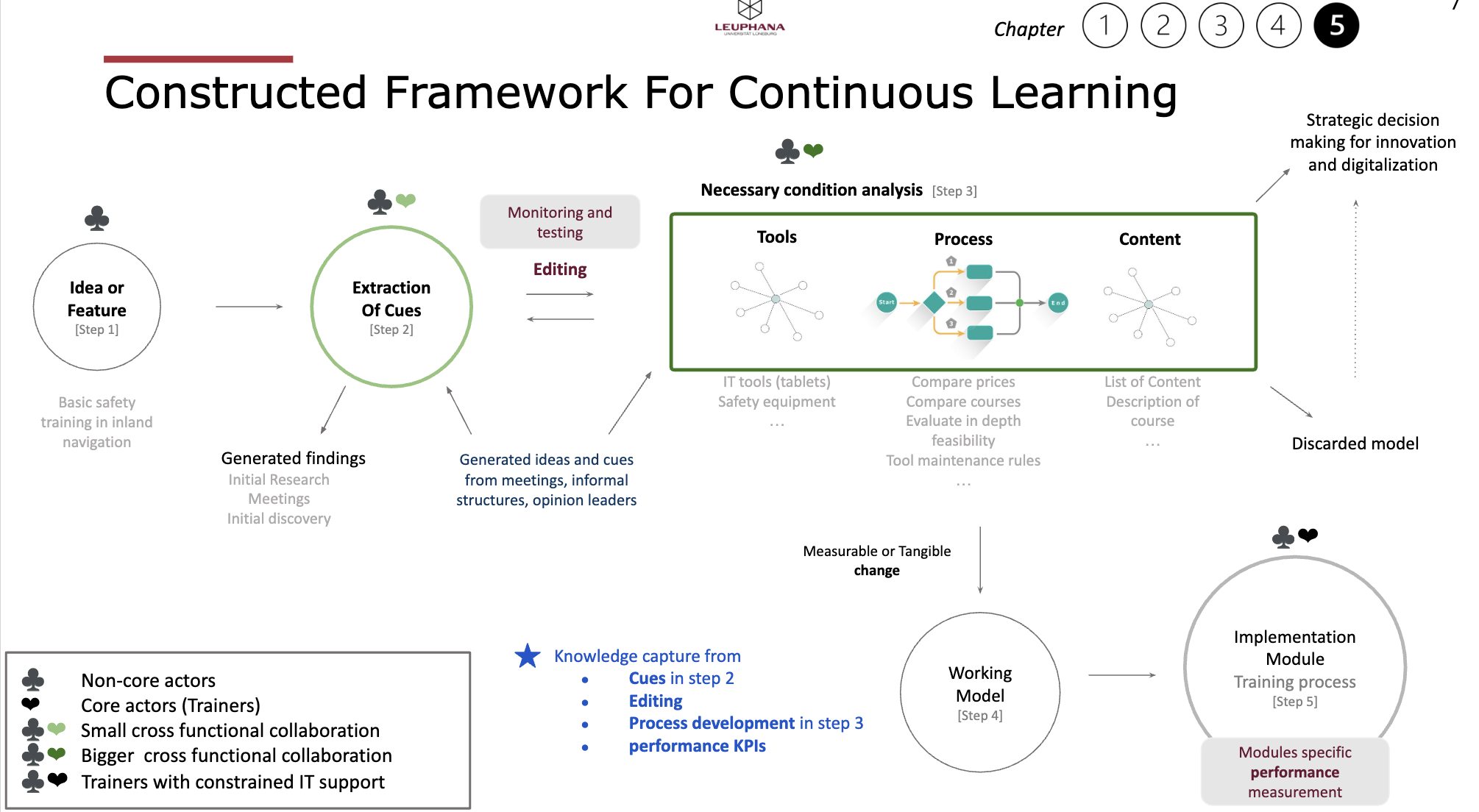
Built specifically for Ma-Co, this framework operationalises continuous learning from idea to implementation:
| Step | Description |
|---|---|
| 1. Idea or Feature | e.g. basic safety training for inland navigation — sourced from staff, informal structures, opinion leaders |
| 2. Extraction of Cues | Initial research, meetings, discovery — gathering signals from the environment |
| 3. Necessary Condition Analysis | Evaluate Tools (IT, equipment), Process (feasibility, pricing, maintenance), Content (course structure) — strategic decision gate |
| 4. Working Model | Measurable or tangible change validated at small scale before full rollout — discarded if not viable |
| 5. Implementation Module | Training process with module-specific performance measurement and KPI tracking |
Knowledge is captured at steps 2, 3 (process development), and 5 (performance KPIs).
Impact of the Framework
- —Standardises the workflow via lean philosophy — reduces waste in decision-making
- —Motivates proportional cross-functional collaboration without overburdening scarce trainer capacity
- —Strategic decisions scoped only to what's necessary — avoids speculative investment
- —Identifies where knowledge is extracted and stored — building institutional memory
- —Distinguishes tangible vs non-tangible change — enables measurable conclusions
Idea Management
To operationalise bottom-up change, all employees can submit ideas evaluated through four questions: What can be modified? How can it be improved? Who is responsible? When will it be implemented? This inclusive approach increases trust and organisational agreeability — a key finding from the interview data.