Future of Data Privacy & Ethics
ResearchResearch Presentation · Leuphana Universität Lüneburg · Timeline considered up to 2021
Overview
A research presentation examining the state and trajectory of data privacy — from regulatory frameworks to emerging technological risks. The core argument: data privacy is not a compliance checkbox but a strategic capability, and the gap between what technology can do and what it should do is widening.
46%
of websites use cookies
83%
of users see targeted ads
86%
of web traffic carries third-party tracking cookies
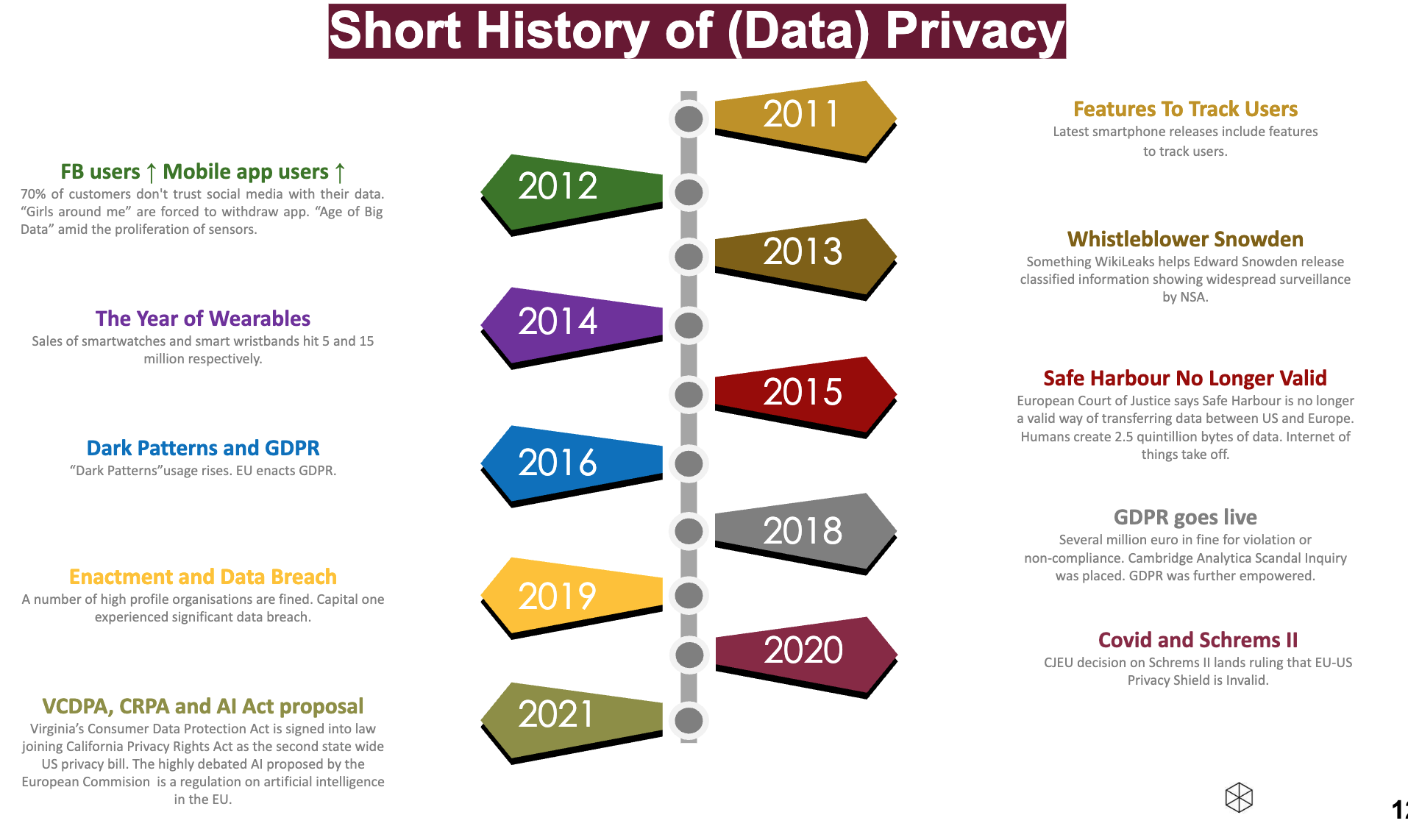
A Short History of Data Privacy (2011–2021)
Regulatory Landscape
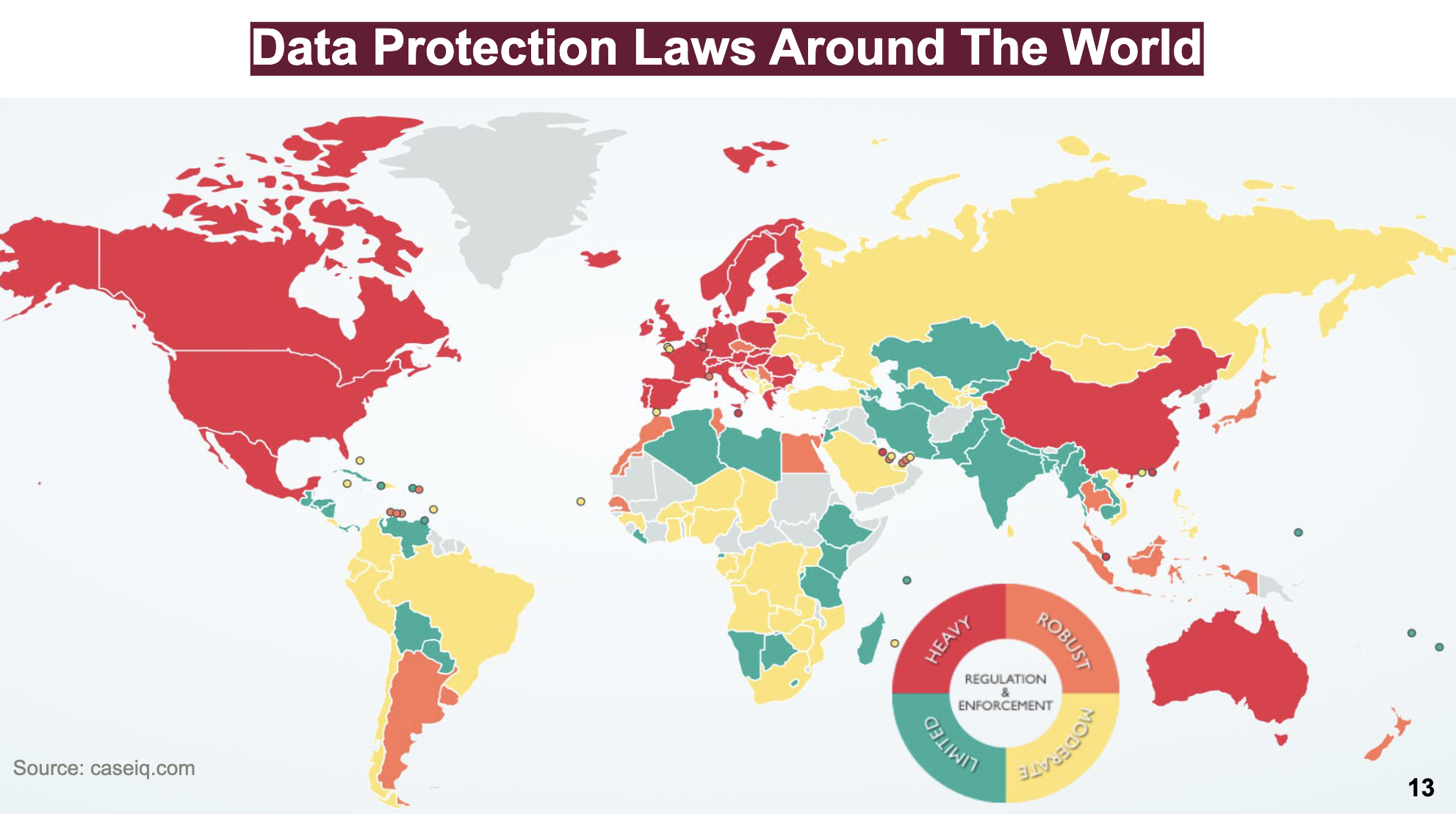
GDPR (EU, 2018) is the global gold standard — heavy fines for non-compliance, and it has directly inspired legislation in Brazil, Japan, and India. But global enforcement remains highly uneven, as shown below.
- —GDPR introduced enforceable data subject rights: access, erasure, portability, objection
- —Brazil's LGPD, Japan's APPI — all GDPR-inspired but locally adapted
- —Enforcement gap: regulation exists globally but capacity to enforce varies dramatically by region
Emerging Technology Risks
| Technology | Risk | Response |
|---|---|---|
| AI | Re-identification of anonymised data; algorithmic bias | Privacy-by-design, federated learning |
| Quantum Computing | Breaks current encryption standards | Quantum cryptography, homomorphic encryption |
| Blockchain | Immutability conflicts with right to erasure | Tailored protocol redesign for compliance |
| Cloud / Edge | Data theft and unauthorised access at scale | Access control policies, early threat detection |
Ethics — The Core Tension
The central question is not what technology can do, but what it should do. Key dilemmas explored:
- —AI bias — models trained on biased data encode and amplify discrimination at scale
- —Data weaponisation — personal data used for manipulation, profiling, and social control
- —Environmental cost — energy and resource demands of large-scale data infrastructure
- —eTA (Ethical Technology Assessment) — assess technology against ethical principles before deployment, not retrospectively
Individual Protection Tools
Future Directions
- —Privacy-first design as default — not bolt-on compliance
- —Stricter global standards with harmonised enforcement
- —AI-driven legislative responses to keep pace with technological change
- —Zero-knowledge proofs and decentralised identity as privacy-preserving primitives